
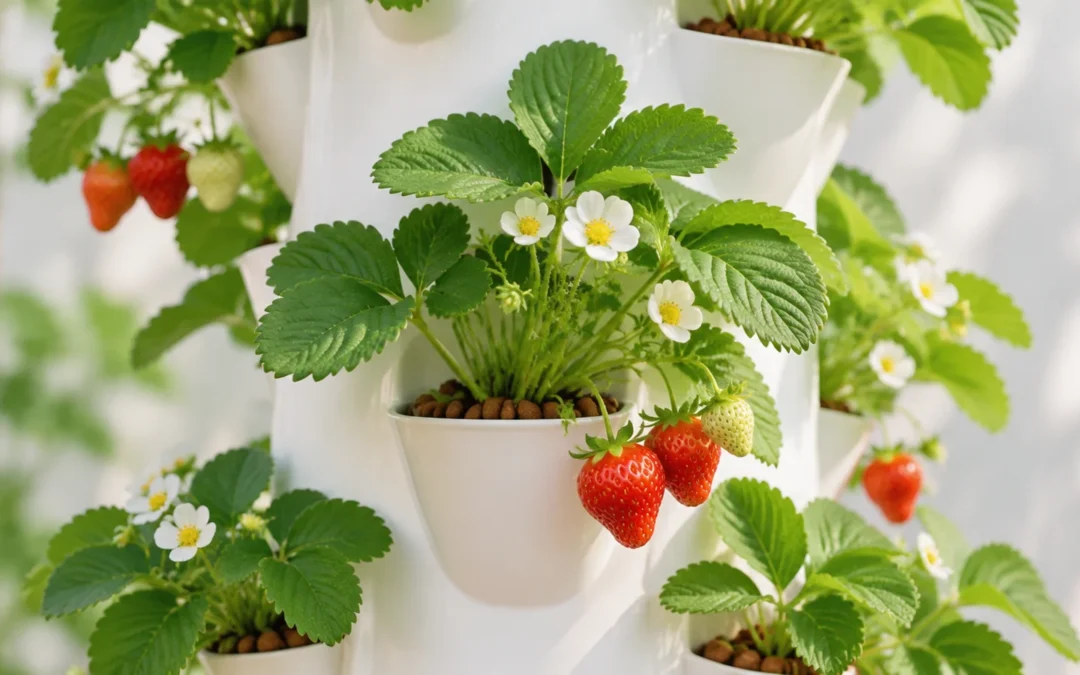
Cover: AI-assisted concept illustration; not a Yunzy product photograph or growing trial.
Yes—strawberries can grow in a hydroponic tower. Illinois Extension observations include day-neutral strawberries grown in vertical stack systems. The important question is whether your tower can provide fruiting plants with enough light, stable root support, reliable water delivery, pollination, and room for developing berries. A tower designed for lettuce may need adjustments before it becomes a suitable strawberry-growing environment.
Start with the right growing conditions
Start with light. Strawberries need strong light to flower and produce fruit. Rutgers Cooperative Extension recommends full sun, ideally at least eight hours of direct sunlight, for outdoor strawberry growing. For indoor setups, light distribution matters just as much as total exposure. Upper leaves can shade lower planting pockets, so check light availability at different heights. Grow lights may be necessary when natural light is insufficient.
Next, choose an appropriate variety. Day-neutral strawberries are worth considering because they can flower over a longer portion of the growing season than June-bearing varieties. However, performance depends on climate, temperature, and growing conditions. In a 2023 Illinois Extension vertical-stack demonstration, growers observed three day-neutral varieties: ‘Monterey,’ ‘San Andreas,’ and ‘Albion.’ These examples demonstrate that strawberries can be grown in vertical hydroponic systems, but they do not establish a universally best variety for every tower or location.
Pay close attention to the crown, the compact growing point from which the leaves, roots, runners, and flower structures develop. Position the plant so its roots are secured in the growing medium while the crown and emerging leaves remain exposed. A crown buried too deeply can be damaged, while one positioned too high may dry out or become unstable. Secure the plant gently and make sure the growing pocket provides enough room for healthy root development.
Plan for flowers, pollination and fruit support
Producing flowers is only the first step. Most cultivated strawberry varieties are self-fruitful, meaning they do not require a second variety for cross-pollination. However, self-fruitful does not mean every flower will be completely pollinated. Strawberry flowers contain many individual reproductive structures, and effective pollen transfer helps berries develop evenly. University of Minnesota Extension explains that insects are important pollinators and that incomplete pollination can contribute to small or misshapen fruit.
For an outdoor tower, bees and other insects may naturally visit the flowers. Indoor growers should not assume pollination will happen automatically. Choose a pollination method appropriate to your growing space and check reliable crop guidance before trying it. If flowers appear healthy but berries develop unevenly, review pollination conditions before assuming the nutrient solution is responsible.
Fruit support also deserves attention. As strawberries develop, their stems and berries need enough space to grow without rubbing against wet tower surfaces or becoming trapped in dense foliage. Keep fruit accessible for inspection and harvesting. If a developing cluster needs additional support, use a clean, gentle support that does not pinch the stem. Good spacing and airflow can also help reduce prolonged moisture around developing fruit.
Check common problems before changing nutrients
When strawberry plants look unhealthy, adding more fertilizer is not necessarily the solution. First, inspect the water delivery system. Is the pump operating correctly? Are the distribution outlets clear? Does nutrient solution reach all planting positions? Is the return path open, without leaks or unexpected pooling? Oklahoma State University Extension emphasizes proper solution distribution, reservoir maintenance, leak prevention, and avoiding nutrient-solution splashing onto leaves in vertical tower systems.
Then inspect the plants themselves. Check for dry or damaged roots, incorrectly positioned crowns, wet foliage, poor airflow, pests, and flowers that fail to set fruit. Small or misshapen berries can result from several factors, including poor pollination, frost damage, insect activity, disease, and nutrient-management problems. Identifying the likely cause first is more useful than immediately increasing fertilizer concentration.
If the physical growing environment is functioning properly, measure the nutrient solution and review water quality, pH, electrical conductivity (EC), and temperature. As University of Missouri Extension explains, EC reflects overall dissolved ions; it does not show whether each nutrient is balanced. Nutrient requirements vary with the crop, water source, and hydroponic system. A single pH or EC reading from another grower’s setup should not be treated as a universal strawberry-growing target.
It is also important to distinguish general growing advice from specific hydroponic observations. The Illinois Extension demonstration used a high-tunnel environment, vertical stacks, perlite-filled planting cubes, and day-neutral strawberry varieties. Its fertigation practices were adjusted to plant growth and environmental conditions, and several crops shared the nutrient program. These observations provide a useful reference for feasibility, not a standardized recipe for every home or commercial tower.
Hydroponic strawberry tower readiness checklist
- Light: Do all planting levels receive sufficient and reasonably even light?
- Variety: Is the selected strawberry cultivar suitable for your climate and intended harvest period?
- Crown: Are the roots secured in the growing medium while the crown and emerging leaves remain exposed?
- Support: Can flower stems and berries develop without rubbing against the tower or sitting in pooled water?
- Pollination: Is there access to outdoor pollinators or a practical hand-pollination plan for indoor growing?
- Water path: Does nutrient solution reach each planting area, drain properly, avoid excessive splashing, and return without leaks?
If these basic conditions are in place, growing strawberries in a hydroponic tower is a realistic project. Start with a manageable number of plants, observe how different planting levels perform, and keep records of changes in growth and fruit development. A successful strawberry tower depends on the entire growing environment—not simply on placing strawberry plants into a vertical system.
For more crop ideas, explore our growing guide.